[Premium Beauty News] The evolution and repositioning of brightening across global markets

![[Premium Beauty News] The evolution and repositioning of brightening across global markets](https://storage.ghost.io/c/29/58/29584234-d41d-4cc7-a520-98b4c87c8015/content/images/size/w1200/2026/01/f67cb98f4b1745fa35687c5ecf0df5.jpg)
This article is originally posted by Jisun Lucie Shin on Premium Beauty News' May 27, 2025 Article. To read the full feature, please visit the link below.
 Jisun Lucie Shin
The term “brightening” remains one of the most frequently mentioned efficacy keywords in both the Korean and Japanese beauty markets. In Southeast Asia as well, the admiration for fair skin still continues. However, the ideal image of brightness that the term evokes is no longer what it used to be.
Rather than simply referring to tone-up effects, an analysis of global e-commerce data from Q1 2025 shows that consumer demand around brightening has become increasingly segmented, diversified, and functionally targeted.
From “brighten” to “targeted” solutions: the segmentation of brightening terminology
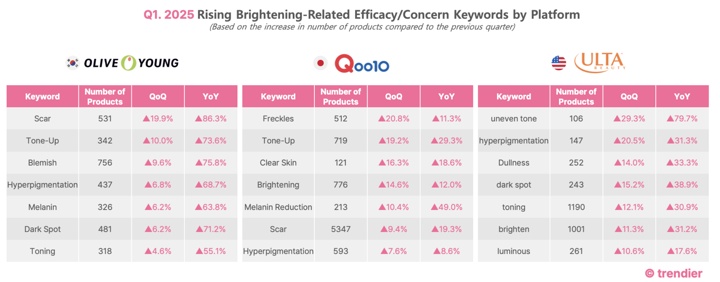
In Korea and Japan, “brightening” is still widely used as a key marketing message, and consumers continue to hold expectations for brightening effects. However, the approach has clearly changed.
In the past, the focus was on ingredients that simply lightened the skin. Now, more refined and sensorial keywords such as - “radiance,” “even skin tone,” “pigmentation reduction,” and “clear complexion” - are redefining what brightening means.
Even in the U.S. market, where the term “whitening” is often considered problematic, keywords like “uneven tone,” “hyperpigmentation,” and “dark spots” are generating strong consumer responses. This suggests that the desire for brightening has not disappeared – but rather, it has evolved into a more sophisticated and specific direction.
Niacinamide and Vitamin C remain strong, but differentiation is now essential
Niacinamide continues to be the most widely used brightening ingredient across Korea, Japan, and the U.S. ingredient. Beyond it well-known brightening benefits, it also helps regulate sebum and strengthen the skin barrier - making it a multifunctional staple across top-performing products on all major platforms.
In fact, it has become the default for brightening formulations.
Vitamin C also remains a symbolic and trusted brightening ingredient. In Q1 2025, it continues to be widely used – particularly in stabilized derivative forms – across leading products in Japan, Korea, and the U.S.
However, as both ingredients become the new “basic”, the challenge is now differentiation. Simply stating “contains Vitamin C” is no longer enough to stand out on the shelf. Brands are no longer competing on what they use, but on how they deliver it.
Brightening for clear and translucent skin — with glutathione at the center
Brightening is no longer just about making skin “brighter”.
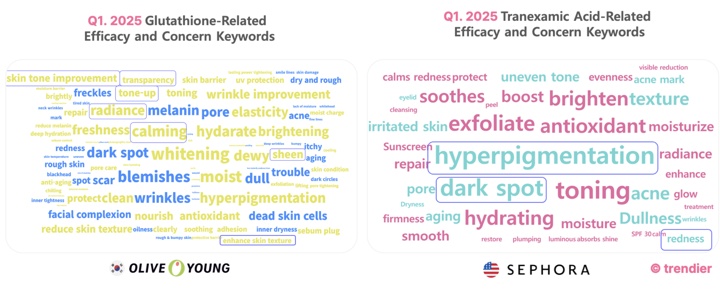
According to brightening-related efficacy and concern keywords from various channels in Q1 2025, consumers now associate brightening with an even tone free of blemishes, a clear and luminous look without dullness, and a natural, healthy glow.
While the preference for fair skin still exists, the standard has shifted toward a more nuanced and multi-dimensional perception of skin.
Rather than just brightness, greater importance is now placed on refined texture, even pigmentation, and the impression of clarity that radiates from deep within the skin.
Alongside this trend, glutathione has emerged as a leading brightening ingredient in Korea.
Once known primarily for inner beauty supplements or injections, it has now expanded into high-performance topical products like ampoules, masks, and tone-up creams.
Glutathione has firmly associated with keywords like “clarity,” “radiance,” “transparency,” and “refined skin texture.”
Tranexamic Acid — A rising star ingredient for targeting dark spots and hyperpigmentation
Once associated primarily with pharmaceuticals, tranexamic acid is now being recognized as a functional ingredient increasingly used in cosmetics.
Although its market share in the U.S. and Japan remains relatively small, it is growing rapidly.
According to a Q1 2025 Sephora keyword analysis, tranexamic acid is being positioned as a targeted, multi-functional solution for concerns such as hyperpigmentation, erythema (redness), and dark spots.
Commonly associated keywords include : “hyperpigmentation,” “dark spot,” “toning,” “even tone,” “redness,” “acne mark,” “calms,” “antioxidant,” and “exfoliate.”