Textured Haircare Trends US 2026 | Products Up 7.43% on Sephora


This article was originally published in BeautyNury. To read the full original article, please visit the link below. View original on BeautyNury →
Sephora US textured haircare grew 7.43% in product count and 6.15% in brand count in just six months.
Products targeting curly, coily, and frizzy hair are expanding simultaneously across the US and UK. trendier AI tracked textured haircare rankings on Sephora, Ulta Beauty, Target, and Amazon UK between January and June 2026.
The clearest signal: heritage curl-specialist brands are rising across three channels at once, while K-beauty brands remain absent from this category entirely.
The K-Beauty Gap Nobody Is Filling
The position of Korean brands in textured haircare is unambiguous. There are no Korean brands in Sephora's textured haircare rankings. Three Korean hair brands entered Ulta Beauty and Target as new entrants during this period, but all three list "all hair types" on their product pages. None targets textured hair specifically.
The gap extends to formulation. Amazon UK's top-ranked textured haircare products feature high-density oil ingredients like argan oil and shea butter as primary actives. Korean brands also use argan oil, but in lightweight formats like perfumed oils and mist sprays. The heavy-butter formulations that coily hair requires are not part of the K-beauty playbook yet.
An "all hair types" positioning trades specificity for breadth. Textured hair consumers look for their curl type explicitly named on a product page. If "coily" or "4c type" does not appear, the product fails to surface in search and fails to convert at the shelf.
No Korean brand has committed to a curl-specific line, which makes this category both an obvious weakness and a first-mover opening.
Frizz Is Bigger Than Curl
trendier AI's Sephora data reveals a counterintuitive category structure. Among products targeting curly, coily, and frizzy hair, the largest subcategory is not curl care but frizz care. Frizz care holds 30.1% share with 569 products. Dry hair care follows at 23.7% (448 products), then damaged hair care at 14.1% (267 products), with curl care at just 11.5% (218 products).
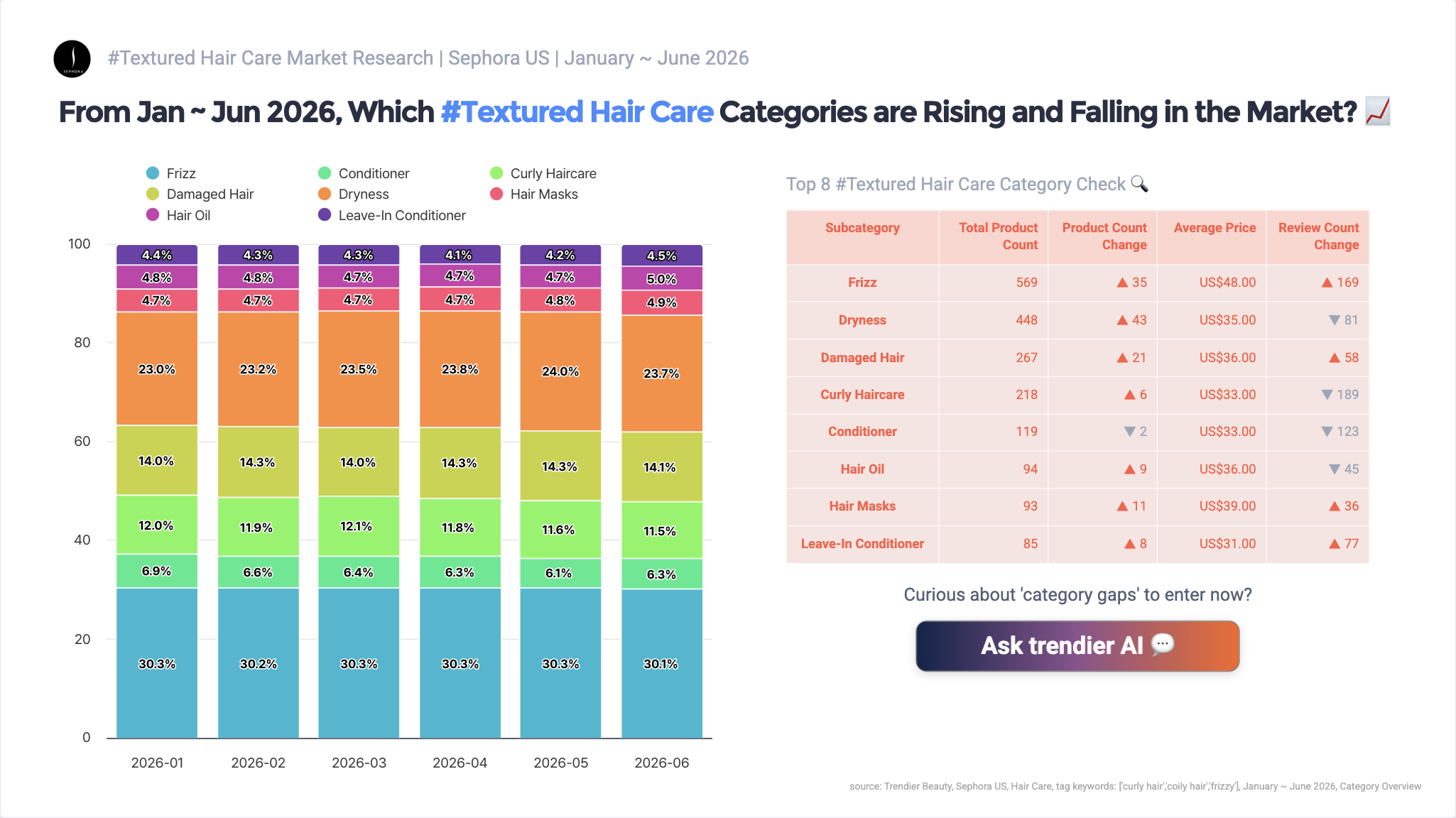
Source: trendier AI — Sephora US, Haircare, Jan–Jun 2026
The implication is clear: even brands that position themselves as curl specialists often generate their ranking gains in the larger frizz category. Frizz is the most common daily frustration for textured hair, so products designed around curl expertise naturally land in the frizz aisle.
One heritage curl brand with over 40 years of history labels its products explicitly "for curly hair," yet its ranking gains came from frizz care. The strategy is to build curl expertise as a line identity while designing products that rank in the bigger category.
This structure directly informs market entry decisions. Positioning exclusively in curl care (11.5%) limits the addressable shelf. Designing products that also rank in frizz care (30.1%) while maintaining curl expertise as the brand story is the common pattern among top performers.
What a 3-Channel Simultaneous Rise Means
The most significant pattern in this data is not any single channel movement but the multi-channel convergence. One heritage curl-specialist brand rose 56 ranks on Sephora, 327 and 237 ranks for two products on Ulta Beauty, and 106 ranks on Target.
This brand, founded in a curly hair salon in the 1980s, has built its own curl-type classification system over four decades. A promotional spike would not explain simultaneous gains across three distinct retail channels.
The UK confirms this is not a US-only phenomenon. Four heritage textured hair brands held top positions simultaneously on Amazon UK's review rankings. These brands have spent decades serving coily and kinky hair exclusively. Their sustained presence signals that textured haircare has a structural demand base across the English-speaking world.
Mass brands are responding quickly. On Target, a mass-market curl cream posted the largest single ranking jump in this dataset at 623 positions. The pattern is familiar from skincare: specialist brands create the category, then mass brands follow with dedicated SKUs.
Why It Matters
For haircare brands eyeing export markets: Textured haircare cannot be entered with a single SKU addition. The brands winning this category maintain line-level expertise in curl and texture, then let the larger frizz care category drive their sales volume. For K-beauty, this means reformulating for texture rather than relabeling existing lightweight products as "for all hair types."
For category planners: Sephora's textured haircare is adding brands at 6.15% in six months, with products and brands growing in parallel. Frizz care at 30.1% is 2.6 times the size of curl care at 11.5%, making it the strategic entry point. Growth is occurring simultaneously in the US and UK, supporting global expansion potential.
Frequently Asked Questions
How fast is textured haircare growing on Sephora US?
trendier AI tracked a 7.43% increase in textured haircare product counts and a 6.15% increase in brand counts on Sephora US between January and June 2026. Both metrics rising together signals category-wide demand expansion.
What is the largest textured haircare subcategory on Sephora?
Frizz care leads at 30.1% (569 products), more than 2.6 times the size of curl care at 11.5% (218 products). Brands that position around curl expertise often generate their actual ranking gains in the frizz subcategory.
Are any Korean brands competing in textured haircare?
Three Korean hair brands entered Ulta Beauty and Target during this period, but all positioned as "all hair types" products. None targets textured hair specifically, and none uses the heavy-butter formulations that coily hair requires.
Why is multi-channel growth significant for textured haircare?
One heritage curl brand rose simultaneously on Sephora, Ulta Beauty, and Target. Four heritage textured hair brands also held top positions on Amazon UK. Simultaneous growth across multiple channels and countries indicates structural category demand, not promotional spikes.
Methodology: trendier AI analyzed haircare category ranking data from Sephora US, Ulta Beauty, Target, and Amazon UK (January–June 2026). This analysis is an expanded version of trendier AI's contribution to BeautyNury.
📊 Explore the full textured haircare rankings, ingredients, and keyword data by channel. View in trendier Library →
#TexturedHaircare #CurlyCare #FrizzCare #KBeautyHaircare #SephoraUS #trendierAI