PDRN Homecare Trends 2026 | Products Up 233% on Amazon

This article was originally published on July 30, 2026, by BeautyNury. To read the full original article, please visit the link below.View original on BeautyNury →
PDRN product listings on Amazon US surged 233% in just six months.
Ingredients once confined to dermatology clinics are migrating to the retail shelf. trendier AI defines this movement as "K-Clinic Homecare," a category of skincare products built around procedure-derived actives like PDRN, exosomes, and spicules that are expanding simultaneously in Korea and the United States.
Repeat clinic visits costing hundreds of dollars per session, combined with recovery downtime, are pushing consumers toward at-home alternatives.
Two Markets, Two Speeds of Adoption
Between August 2025 and February 2026, PDRN product counts on Olive Young rose 42.8%. Over the same period, Amazon US recorded a 233% increase. Korea leads in absolute scale, but the US growth rate runs more than five times faster. A well-established ingredient in Korea is entering early-stage explosive adoption in America.
The gap reflects market maturity. Korean consumers already know PDRN by its popular nickname "salmon injection," while the ingredient remains largely unfamiliar to US shoppers. Early-stage categories naturally show steeper percentage gains, but 233% signals genuine demand beyond a novelty effect.
On Olive Young, 20 new brands entered the PDRN category during this window and top-500 product counts grew from 60 to 74. When brand count and product count rise together, the signal points to category-wide expansion rather than a single-brand spike.
Five Ingredients, Three Growth Tiers
Clinic-derived ingredients on Olive Young fall into a clear hierarchy. trendier AI's data shows PDRN leading at 42.8%, followed by exosomes at 34.4% and spicules at 28.0%. Dexpanthenol (11.5%) and tranexamic acid (6.7%) trail significantly.
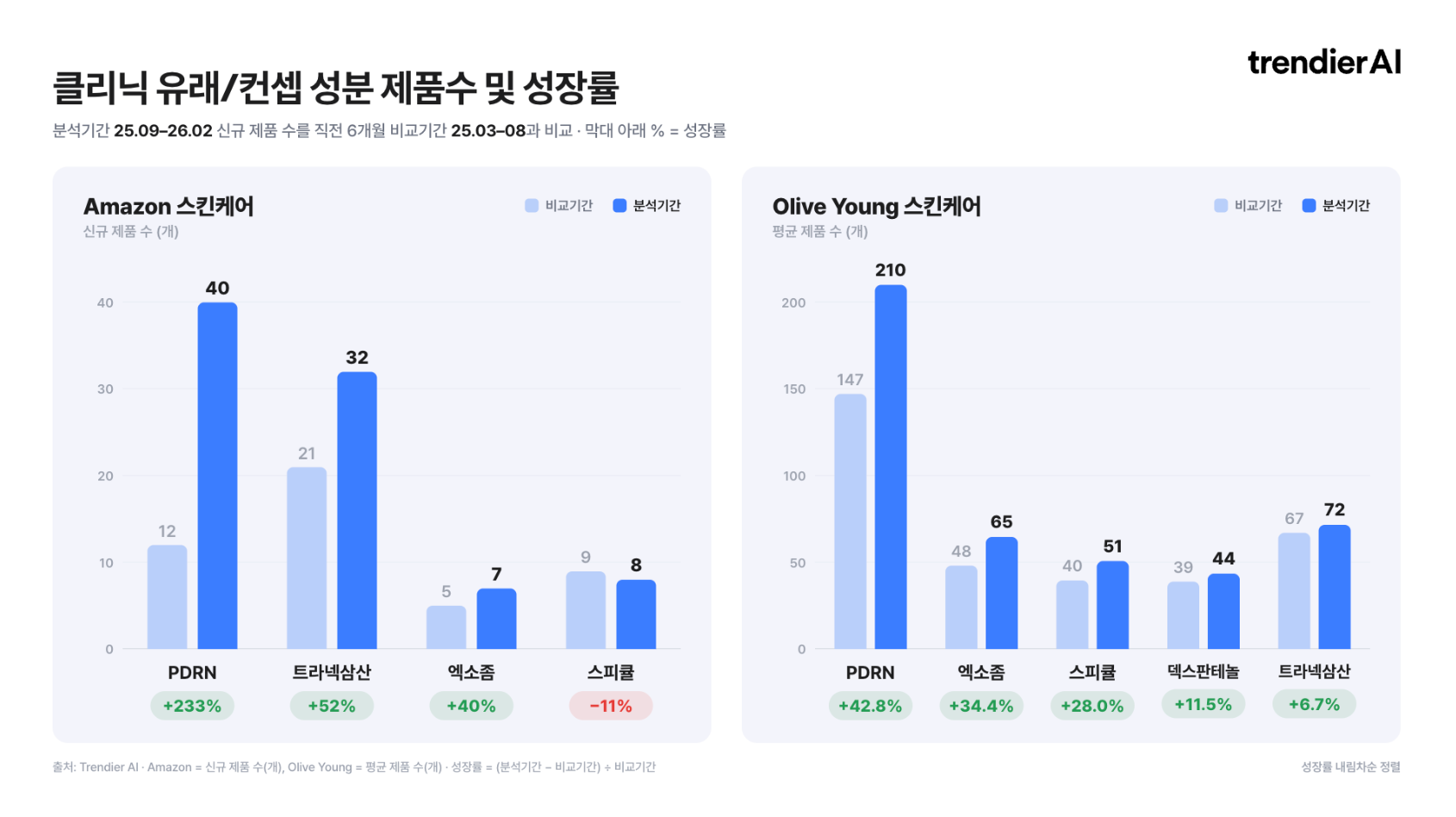
Source: trendier AI — Olive Young, Skincare, Aug 2025–Feb 2026
The 8.4 percentage-point gap between PDRN and exosomes is telling. Both originate from regenerative procedures, but PDRN converts to homecare faster because consumers already associate it with clinical efficacy, requiring no additional education.
For dexpanthenol and tranexamic acid, the "clinic-derived" framing adds little purchase incentive because shoppers already consider them standard skincare ingredients. The clinic origin story works only when consumers still categorize the ingredient as belonging to the treatment room, not the vanity shelf.
Why It Matters
For brand strategists: The clinic-to-shelf conversion is a storytelling problem, not an ingredient selection problem. Consumers now evaluate cosmetics as extensions of clinical procedures. Weaving procedure context into product claims is the differentiator, not the active ingredient itself.
For companies targeting the US market: Amazon US PDRN is a near-monopoly at 64.7%, but on Sephora a newcomer brand reached #2 in skincare within three months. Channel-level competitive dynamics vary sharply, so entry point selection determines outcomes. The US market has not yet reached Korea's level of brand saturation, making this a favorable entry window.
Brand Concentration and Late-Mover Opportunity
Korea and the US show contrasting competitive structures. On Olive Young, the leading brand holds roughly 30% share while 20 new entrants still found room. On Amazon US, a single K-beauty brand commands 64.7%, a near-monopoly.
That concentration gap is the opportunity. A category growing at 233% but dominated by one player means consumer demand is outpacing available choices. This structure rarely sustains itself.
trendier AI's Sephora brand ranking data illustrates how quickly disruption happens. One clinic-ingredient skincare brand entered as a newcomer in Q1 2026, debuting at #34 in overall skincare, then climbing to #2 within three months. Credibility built in the treatment room translated directly into retail velocity.
In Korea, clinic companies are also expanding into homecare. One collagen-booster procedure specialist reformulated its treatment-grade PDLLA into a retail skincare line now sold on Olive Young, bringing a procedure-room active into daily routines.
Consumers Are Writing New Product Language
The most revealing signal comes from consumer reviews. Olive Young skincare reviews now include expressions borrowed from clinical procedure experiences, language that appears nowhere on brand product pages. Consumers are spontaneously framing cosmetics as extensions of professional treatments.
When shoppers evaluate skincare through a clinical lens, their purchase criteria shifts. The deciding factor becomes not "does this ingredient work?" but "where was this ingredient originally used?"
One major domestic skincare brand recognized this shift and designed its product around it, borrowing procedure terminology directly into the product name and using proprietary clinical data to draw direct comparisons with professional treatments.
Frequently Asked Questions
How much have PDRN homecare products grown on Olive Young?
trendier AI tracked a 42.8% increase in PDRN product counts on Olive Young between August 2025 and February 2026. During that period, 20 new brands entered the category and top-500 listings rose from 60 to 74.
How fast is PDRN expanding on Amazon US?
Amazon US PDRN product counts grew 233% over the same six months. While absolute market size is smaller than Korea's, the growth rate is more than five times higher, indicating early-stage rapid adoption.
What is K-Clinic Homecare?
A term defined by trendier AI describing the trend where ingredients originally used in dermatology procedures or pharmaceuticals (PDRN, exosomes, spicules) are being reformulated into everyday skincare products.
Which clinic-derived ingredient is growing fastest on Olive Young?
PDRN leads at 42.8%, followed by exosomes (34.4%) and spicules (28.0%). Dexpanthenol (11.5%) and tranexamic acid (6.7%) show slower growth as consumers already perceive them as standard skincare ingredients rather than clinic-exclusive actives.
Why is brand concentration on Amazon US significant?
One brand holds 64.7% of PDRN product share on Amazon US, creating a near-monopoly. As the category grows at 233%, this concentration signals unmet consumer demand and a window for new entrants before the market matures.
Methodology: trendier AI analyzed product data from Olive Young and Amazon US skincare categories (August 2025–February 2026). This analysis is an expanded version of trendier AI's contribution to BeautyNury.
📺 Watch the full K-Clinic Homecare discussion on YouTube.
From the Clinic to Your Bathroom Shelf — PDRN, Exosomes & Clinic-Grade Skincare
#PDRNSkincare #KClinicHomecare #ClinicToShelf #OliveYoung #AmazonBeauty #trendierAI