Global Hair Care Trends 2026 | Five Markets, Five Different Playbooks

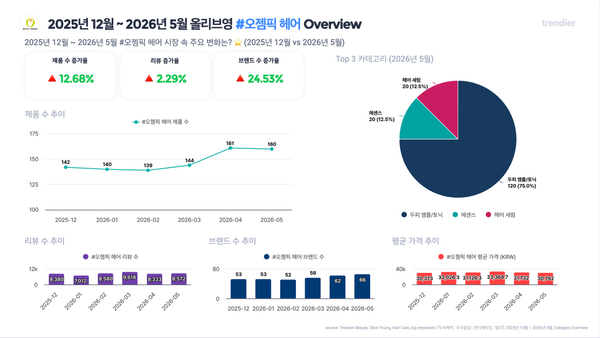
Across five markets in trendier AI's hair care review analysis for the first half of 2026, the category is not converging on one model. Korea organises hair care around the scalp, Japan around biotech actives, the US around systems, and the UK around conditions. In Korea's thinning-related segment, scalp ampoules alone accounted for 75% of tracked Olive Young products.
The same category, five different organising units. A product built for one of them does not automatically read as relevant in the others.
Korea And Japan: Scalp First, Then Biotech
Korea has moved hair care onto the scalp and started treating the scalp as skin. Skinification leads the Korean ingredient signals, and the format followed the framing: scalp ampoules made up 75% of tracked Olive Young products in the emerging thinning-related segment, with one Korea ranking report showing an 85-place jump on Naver.
Japan arrived at scalp care from a different direction. Biotech actives lead the Qoo10 Japan ingredient signals rather than skincare-borrowed language, which is a supply-side framing where Korea's is a routine-side one.
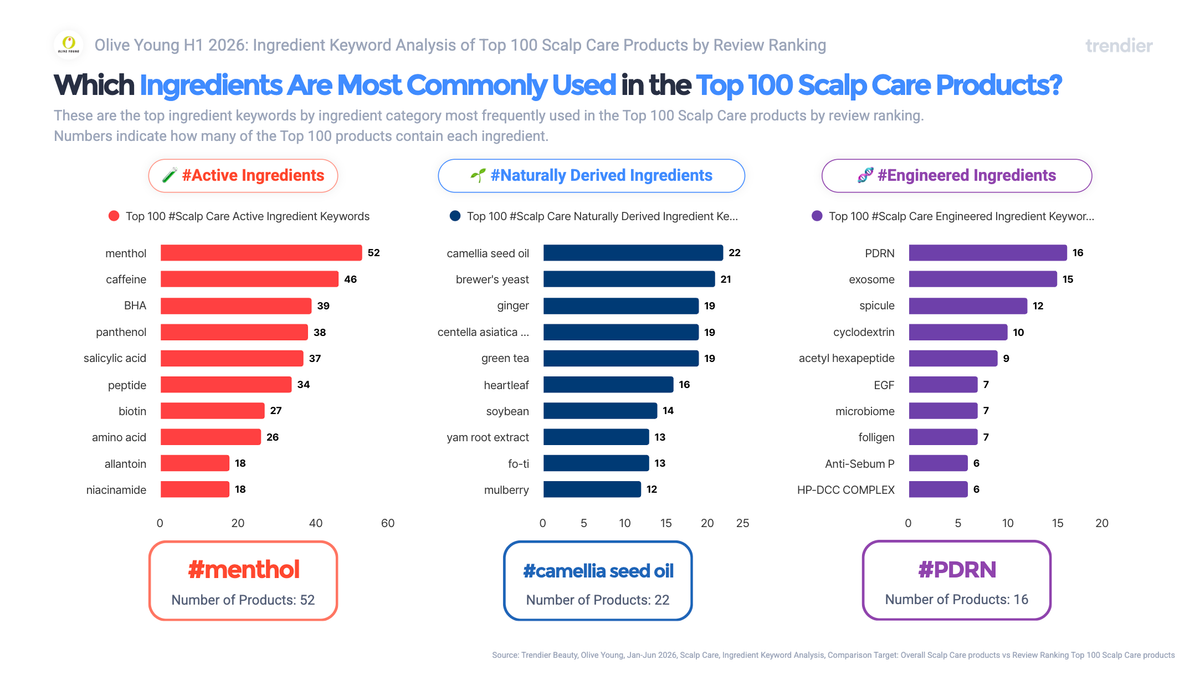
Both markets treat the scalp as the site of the problem. They disagree about what belongs on it. The scalp care ingredient comparison sets the three markets side by side.
The US: The System, Not The Product
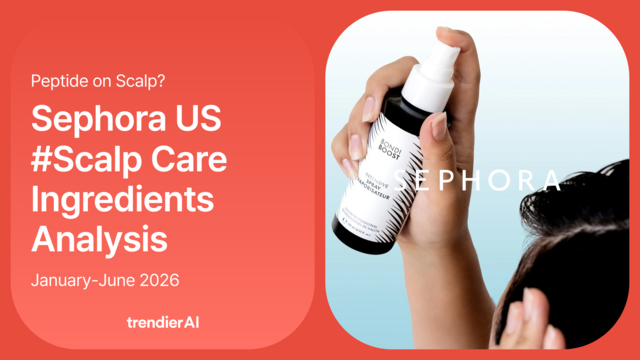
The US organises around regimens. Peptides lead the Sephora US scalp ingredient signals, and the buying unit is frequently a set rather than a single product.
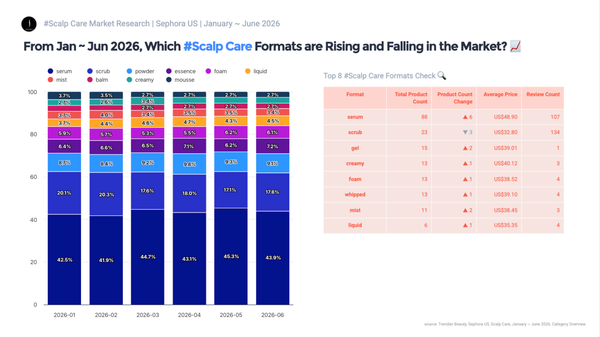
Two figures show the pressure that creates. Hair spray grew 13% on Sephora US as styling shifted toward hold and precision. Meanwhile US scalp care review volume fell 33% across the half even as the product count rose.
The format brands kept launching was also not the one shoppers reviewed most: serum carried 88 products and drew 107 reviews, while scrub drew 134 reviews from 23 products.
A crowded shelf with falling engagement is a different launch problem from an emerging one. The US scalp care collection covers that in nine reports.
The UK And Germany: Conditions, Not Ingredients
The UK signals are about performance in use. Curl definition and weatherproofing are rising in Amazon UK textured hair reviews, which is consumer language about circumstances rather than about actives.
Germany is earlier. Textured hair care is gaining ground across retailers there, but the signals are directional rather than settled, and the category is still establishing its own vocabulary.
Sephora US shows sharp product movement in the same category, so textured hair is not one market with three storefronts. The textured hair collection tracks all three.
The Map
| Market | Hair care is organised around | Clearest signal, H1 2026 |
|---|---|---|
| Korea | The scalp, treated as skin | Scalp ampoules at 75% of tracked Olive Young products |
| Japan | Biotech actives | Biotech leads Qoo10 Japan ingredient signals |
| US | Systems and regimens | Peptides lead Sephora US; hair spray up 13% |
| UK | Conditions and performance | Curl definition and weatherproofing rising on Amazon UK |
| Germany | Still establishing | Textured hair care gaining ground across retailers |
What This Changes For A Launch
The usual question is which hair care trend to follow. These five markets suggest a different one: which organising unit does the destination market already use, and does the product fit inside it.
A Korean scalp ampoule enters the US against regimen sets and peptide claims. A US system enters the UK against language about curl definition and weather. The formulation may travel; the framing rarely does without work.
Two caveats. Each market is read through one or two retailers rather than the whole country, so these describe those shelves. And the German signals are the thinnest in the set, which is why the entry above is directional. The styling collection and the thinning collection hold the market-by-market detail.
Methodology: trendier AI hair care review analysis, first half of 2026. Korea via Olive Young and Naver, Japan via Qoo10 and @cosme, the US via Sephora, Ulta, Amazon and Target, the UK via Amazon UK, and Germany via major retailers. Ingredient, ranking and keyword signals are drawn from product review data in each market.
📊 Where this data comes from:
- Scalp Care Ingredient Trends: skinification, biotech and peptides compared across Korea, Japan and the US, 3 reports
- Ozempic Hair Trends: the products, actives and keywords behind the Korea and Japan thinning segment, 6 reports
- Hair Styling Trends: hold, care and precision across Olive Young, Naver, Sephora US and Ulta, 6 reports
- Textured Hair Care: rankings, brands and keywords across the US, UK and Germany, 7 reports
- US Scalp Care: category, ranking, ingredient, format, price and claims analysis across four US retailers, 9 reports
💬 The one question worth running yourself on trendier AI:
"Compare the top hair care review keywords in Korea, Japan and the US for H1 2026. Which market would my product fit?"
Frequently Asked Questions
What is trendier AI? trendier AI is beauty market intelligence software for brand, R&D and marketing teams. It reads consumer review text across 30+ global marketplaces and returns ranked review keywords, product and brand rankings, and category analysis by market and period. Questions can also be asked directly in AI Chat and answered from the same review data.
What are the biggest hair care trends in 2026? They differ by market rather than being global. Korea leads with scalp skinification and ampoule formats, Japan with biotech actives, the US with peptides and regimen systems, and the UK with curl definition and weatherproofing in textured hair reviews.
What is scalp skinification? Treating the scalp as skin, so scalp products borrow the ingredients, formats and claims of facial skincare. In trendier AI's H1 2026 analysis it leads the Korean scalp care ingredient signals, and scalp ampoules accounted for 75% of tracked Olive Young products in the thinning segment.
#HairCare #GlobalTrends #ReviewAnalysis #MarketIntelligence #ConsumerInsights